General Contest
Since the beginning of the full-scale invasion, cyberattacks on Ukrainian critical infrastructure and government information resources have become one of the main facets of russia’s war against Ukraine. Such cyberattacks were not something new for Ukraine, as, de facto, the country has been resisting russian aggression since 2014. According to Microsoft Digital Defence Report, Ukraine is consistently among the top-3 countries most impacted by nation-state cyber threat activity.
Efforts to weaken international backing for Ukraine have also extended beyond its borders, particularly into Europe, with growing frequency. Ukraine’s cyber resilience evolved from a national concern into an international one. It became increasingly evident that responding effectively to these threats required collective action. This recognition laid the groundwork for what is now known as the Tallinn Mechanism.
The Launch of the Tallinn Mechanism and Member States
On December 20, 2023, the Ministries of Foreign Affairs of Ukraine, Canada, Denmark, France, Germany, the Netherlands, Poland, Sweden, the United Kingdom, and the United States Department of State (DoS), at the initiative of the Estonian Ministry of Foreign Affairs, announced the launch of a new instrument of international cooperation. This initiative was named the Tallinn Mechanism after the location of the initial meeting.
The main goal of the Tallinn Mechanism is supporting cybersecurity, strengthening cyber defense and cyber resilience, as well as developing Ukraine's civilian cyber capacity through systematic coordination of international assistance. A systematic approach is the main feature that distinguishes the Tallinn Mechanism from other similar formats of international assistance.
As of April 2026 TM includes 14 countries: the United Kingdom, Denmark, Estonia, Italy, Canada, the Netherlands, Germany, Poland, the United States, France, Sweden, Norway, Finland, and the Czech Republic.
The EU, NATO and the World Bank are official observers.
Tallinn Mechanism Leadership
The Tallinn Mechanism is chaired by leading nations chosen on a rotating basis for a six-month term, with the possibility of extension by mutual agreement. As of December 2025, the United Kingdom holds the chairmanship. The Coordination Group operates within TM, comprising representatives from all member states and official observers.
Functions:
-
Supervise TM activities
-
Develop TM policy and strategic directions
-
Review project implementation progress
-
Make decisions on key issues and discuss strategic development paths
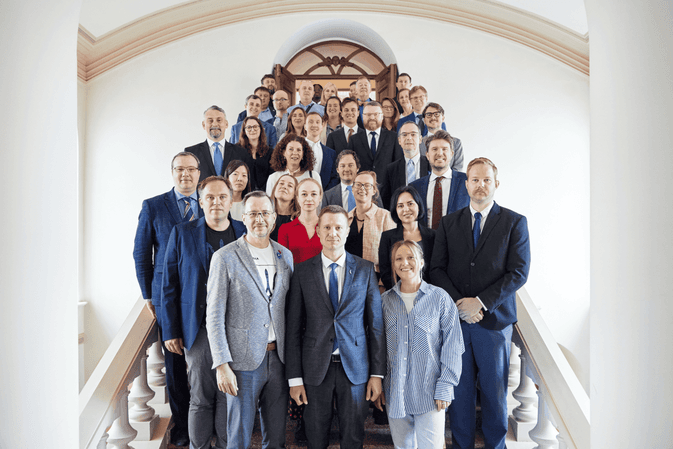
The Coordination Group meets at least twice a year in a location determined by the lead country. The last meeting took place in March in London, the previous one was in Paris in October 2025.
Meeting in Paris
Ukrainian Governmental Counterparts:
-
Ministry of Digital Transformation of Ukraine
-
State Service of Special Communications and Information Protection (SSSCIP)
-
Ministry of Foreign Affairs
-
Security Service of Ukraine
-
National Cybersecurity Coordination Center (NCSCC)
The Tallinn Mechanism Founding Principle
A core aspect of the Tallinn Mechanism’s strategy is its alignment with Ukrainian priorities.
Guided by the principle “Nothing about Ukraine without Ukraine,” all assistance is developed in close collaboration with Ukrainian governmental counterparts. This ensures that aid is both relevant and effective, addressing immediate vulnerabilities while building the foundation for long-term resilience.
Focus on Long-Term Cyber Resilience
The Tallinn Mechanism integrates immediate assistance with sustained capacity-building to ensure the resilience of Ukraine’s digital ecosystem. This comprehensive approach was outlined in the TM’s Mission Statement, which defines three key Lines of Effort (LoE).
- Support (Short-Term Effort)
Provide immediate assistance to address urgent cybersecurity needs. Stabilize and strengthen Ukraine's existing cybersecurity infrastructure. Build capacity for rapid response to cyber incidents.
- Build (Medium-Term Effort)
Develop and implement sustainable cybersecurity solutions. Strengthen Ukraine's cybersecurity workforce and expertise. Enhance public-private sector collaboration.
- Sustain (Long-Term Effort)
Ensure the long-term sustainability of Ukraine's cybersecurity capabilities. Promote innovation and research.

