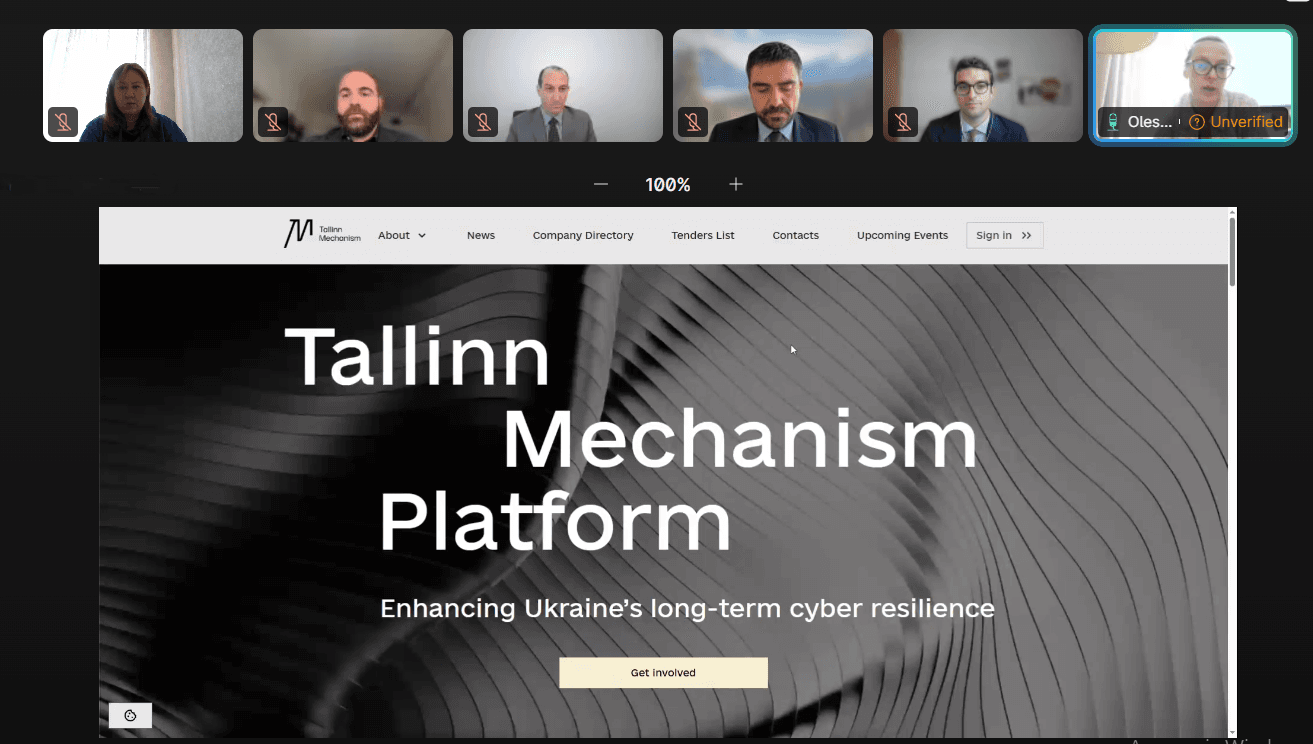
The Ministry of Foreign Affairs and International Cooperation of Italy, together with TMPO held a webinar for Italian private cybersecurity companies.
The event introduced companies to the Tallinn Mechanism and the opportunities available through the Tallinn Mechanism Platform. Participants learned how they can join the Platform, connect with Ukrainian and international partners, and contribute their expertise to cybersecurity projects supporting Ukraine.
Why private-sector engagement matters
Strengthening public-private partnerships and encouraging private business involvement in Tallinn Mechanism activities are among Italy’s priorities during its Chairship of the Tallinn Mechanism. Greater participation of Italian companies on the Platform supports this goal and can help build new partnerships between the Italian and Ukrainian cybersecurity sectors.
Opening the webinar, Alessandro de Pedys, Director General for Cyber Issues, Information Technology and Technology Innovation at the Italian Ministry of Foreign Affairs and International Cooperation, emphasized Italy’s commitment to the Tallinn Mechanism, also recalling the role played by the Italian cyber capacity building ecosystem. Against this backdrop, he stressed the importance of continued support for Ukraine and closer cooperation at both government and private-sector levels. He, thus, encouraged more Italian companies to register in the Tallinn Mechanism Platform.
Nicolò Costantini, Head of the Cyberdiplomacy Office, presented the Tallinn Mechanism and outlined the priorities of Italy’s Chairship. He particularly highlighted the importance of supporting Ukraine’s regions and local authorities. Cyberattacks affect not only central government institutions but also organisations at the local level, which may have fewer resources to protect themselves.
Olesya Danylchenko, Head of TMPO, presented the Tallinn Mechanism Platform and explained how companies can register and explore opportunities for cooperation. She also outlined how the Platform helps connect partners, support project development and strengthen international cooperation within the Tallinn Mechanism.
From cooperation to real projects
A key part of the webinar focused on practical examples of how private companies can contribute to Tallinn Mechanism projects. As of September 2026, 10 projects with a total value of more than €10.5 million have been completed under the Tallinn Mechanism. More than 20 projects worth over €11.5 million are currently being implemented.
These projects strengthen cybersecurity infrastructure, improve institutional capabilities and help Ukrainian organisations detect and respond to cyber threats more effectively. Together, they contribute to strengthening Ukraine’s overall cyber resilience.
Kostiantyn Moskvin from the Ukrainian cybersecurity company IT Specialist shared the company’s experience of implementing a project for the Chornobyl Nuclear Power Plant. The project focused on improving the security of authentication processes. He spoke about the practical aspects of the implementation process and shared lessons learned.
The perspective of a Ukrainian recipient was presented by Taras Kvachuk, Deputy Head of the Ternopil Regional Military Administration. Italy has allocated almost €900,000 to strengthen cyber resilience in Ukraine’s Ternopil region. Taras Kvachuk thanked Italy for its support and highlighted the practical impact of the projects. They helped modernise the region’s digital infrastructure, strengthen the protection of public services and support their uninterrupted operation amid growing cyber threats.
Engagement with cybersecurity companies has become an important part of TMPO’s work. In 2026, 12 introductory webinars on the Tallinn Mechanism Platform were held for private-sector representatives from Norway, Poland, the United Kingdom, the Netherlands, Germany, France, the United States, Estonia, the European Cyber Security Organisation (ECSO), and now Italy.
These activities help more companies understand how the Tallinn Mechanism works, find opportunities for cooperation and bring their expertise to projects that strengthen Ukraine’s cyber resilience.