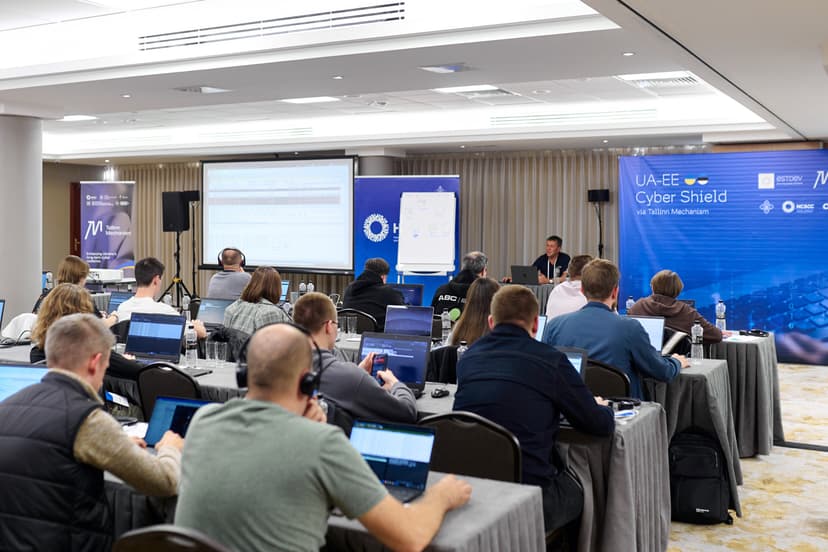
Ruslana Korenchuk, CEO of Diia.Education, CDTO Campus, and Manager of joint projects of the East Europe Foundation and the Ministry of Digital Transformation of Ukraine, explores how CDTO Campus — Ukraine’s national educational project for digital transformation leaders — strengthens cyber leadership in the public sector through its partnership under the Tallinn Mechanism. The article explains why investing in people, skills, and institutional capacity is as critical to cybersecurity as technology itself, and how education becomes a strategic tool for long-term national and international cyber resilience.
CDTO Campus is a unique project that trains and upskills digital transformation leaders and their teams in the public sector. It equips them to design, implement, and sustain digital change. The partnership within the Tallinn Mechanism allows CDTO Campus to transfer knowledge and to embed sustainable skills and practices across Ukraine’s public sector, contributing to long-term cyber resilience for Ukraine and its international partners.
A Strategic Response to Evolving Threats
The emergence of CDTO Campus was a response to a systemic need of the Ukrainian state to cultivate a new generation of digital leaders capable of initiating and delivering digital projects across ministries, central executive authorities, regional administrations, and local communities. While maintaining a strong focus on Ukraine’s digital transformation, CDTO Campus actively integrates international expertise and best practices into its educational model.
The educational model of CDTO Campus combines strategic leadership training with hands-on technical expertise. Its programs are designed for civil servants, managers, and technical professionals who are directly responsible for digital services, data protection, cybersecurity, and institutional resilience.
CDTO Campus operates through several core faculties that address key dimensions of public sector digital transformation:
-
GovTech Faculty prepares a new generation of public sector leaders capable of driving digital transformation and innovation, building transparent, citizen-centric institutions, and applying technology, policy, and leadership tools to address complex societal challenges.
-
AI Faculty equips public sector leaders and teams with practical knowledge on artificial intelligence, data analytics, and responsible AI use in government.
-
Diia Faculty is designed for internal training and capacity building within the ecosystem of the Ministry of Digital Transformation of Ukraine.
-
Cybersecurity Faculty, which has evolved into CISO Campus, prepares cybersecurity leaders and professionals responsible for protecting government systems and critical infrastructure.
Building the Capacity under the Tallinn Mechanism
In addition to its core faculties, CDTO Campus implements a dedicated portfolio of educational programs within the framework of the Tallinn Mechanism. Since 2025, the CDTO Campus has been an active educational partner of the Tallinn Mechanism, jointly designing and delivering training programs that directly support Ukraine’s cyber resilience priorities.
Together with partners, CDTO Campus has already developed and delivered 16 specialized cybersecurity programs under the Tallinn Mechanism. These programs address both foundational and advanced needs of public sector institutions and operators of critical infrastructure.
The portfolio includes training in:
-
information security (basic and advanced),
-
network security and incident response,
-
OSINT and cyber threat intelligence,
-
SOC operations, SIEM, and intrusion detection,
-
ethical hacking and penetration testing,
-
digital forensics, malware analysis, and advanced incident response,
-
cyber defense of operational technology (OT) and critical infrastructure.
International partners such as Expertise France, Monarch and Software Engineering Institute (SEI) provide deep technical expertise and real-world operational knowledge, while CDTO Campus ensures contextualization, institutional relevance, and alignment with Ukraine’s national cybersecurity priorities.
Through this cooperation, education becomes a strategic instrument — strengthening human capital, increasing institutional readiness, and enabling rapid adaptation to evolving cyber threats.
Looking ahead, the cooperation will continue to evolve through new capacity-building initiatives under the CISO Campus framework, ensuring continuity of the Tallinn Mechanism’s objectives. CDTO Campus remains open to cooperation with additional international partners to further strengthen Ukraine’s cybersecurity ecosystem and resilience.
To get more information about the joint training program under the Tallinn Mechanism, please visit the CDTO Campus website and social media channels.
CDTO Campus is implemented by East Europe Foundation under the patronage of the Ministry of Digital Transformation of Ukraine. The initiative is supported by Visa Foundation, the Federal Ministry for Economic Cooperation and Development of Germany (BMZ), Deutsche Gesellschaft für Internationale Zusammenarbeit (GIZ) GmbH, and Switzerland within the framework of EGAP Program implemented by East Europe Foundation. The technology partner is Cisco.
Key Achievements
-
over 1,600 graduates currently working across the public sector,
-
over 6,600 applications received for educational programs,
-
40 educational programs delivered,
-
more than 150 lecturers, including Ukrainian and international digital leaders.